
Understanding the atmospheric layers – troposphere, stratosphere, mesosphere, thermosphere, and exosphere – is crucial for grasping weather patterns and space environments.
Worksheets often focus on matching layer descriptions, like weather occurring closest to Earth, or identifying gases within each atmospheric region.
NASA provides valuable resources, including activities, to explore these layers, from ozone concentration to radio wave reflection points.
What is the Atmosphere?
The atmosphere is the gaseous envelope surrounding Earth, held in place by gravity. It’s a complex system of layers, each with unique characteristics impacting our planet’s climate and supporting life. Worksheets frequently introduce this concept by asking students to identify these layers – troposphere, stratosphere, mesosphere, thermosphere, and exosphere – based on altitude and key features.
These layers aren’t sharply defined but transition gradually. Understanding the atmosphere’s composition – nitrogen, oxygen, and trace gases – is fundamental. Educational materials often present puzzles where students match atmospheric gases to their respective layers. The atmosphere protects us from harmful radiation and regulates temperature, making it essential for survival. Resources like NASA provide detailed information for deeper exploration.
Why Study Atmospheric Layers?
Studying atmospheric layers is vital for comprehending weather patterns, climate change, and space exploration. Worksheets often challenge students to correlate specific phenomena – like meteor burning or jet stream location – with their corresponding atmospheric layer. This knowledge aids in predicting weather events and understanding the impact of human activities.
Furthermore, understanding the ionosphere’s role in radio wave reflection is crucial for communication technologies. Educational resources emphasize the importance of the ozone layer in shielding us from harmful UV radiation. Investigating these layers also informs satellite deployment and space travel. NASA’s resources provide valuable insights into these complex interactions, fostering a deeper appreciation for our planet’s protective shield.

The Troposphere: Our Weather Layer
This lowest layer, closest to Earth, is where almost all weather occurs, a key focus of atmospheric layer worksheets and studies.
Altitude and Characteristics of the Troposphere
The troposphere extends from the Earth’s surface up to approximately 7-12 kilometers (4-7.5 miles) in altitude, though this varies with latitude; it’s higher at the equator and lower at the poles.
Worksheets frequently ask students to identify this layer as the one where temperature generally decreases with increasing altitude, a crucial characteristic.
It contains roughly 75-80% of the atmosphere’s mass, making it the densest layer, and is characterized by significant vertical mixing due to convection currents.
Most of the water vapor in the atmosphere is found here, leading to cloud formation and precipitation, elements often highlighted in educational materials.
Understanding these characteristics is fundamental when completing atmospheric layer matching exercises found in many PDF worksheets.
Weather Phenomena in the Troposphere
The troposphere is the primary location for all our familiar weather phenomena, including rain, snow, wind, and storms. Worksheets often present scenarios requiring students to identify these events within this layer.
Convection, driven by uneven heating of the Earth’s surface, creates air currents that lead to cloud formation and precipitation, key concepts tested in atmospheric studies.
Hurricanes, tornadoes, and thunderstorms all develop and exist entirely within the troposphere, demonstrating its dynamic nature.
PDF worksheets frequently include diagrams illustrating these weather systems and their relation to temperature and pressure gradients.
Understanding these phenomena is vital for interpreting weather maps and completing related exercises found in educational resources.

The Stratosphere: Ozone and Stability
Worksheets emphasize the stratosphere’s stable conditions and the crucial ozone layer, protecting life from harmful radiation, alongside jet stream concepts.
The Ozone Layer and its Importance
Educational materials, like atmospheric layers worksheets, frequently highlight the ozone layer within the stratosphere as a vital component of Earth’s protection. These resources detail how ozone (O3) absorbs the majority of the Sun’s harmful ultraviolet (UV) radiation, preventing it from reaching the surface.
Worksheet activities often ask students to identify the stratosphere as the layer hosting this critical shield and explain its role in safeguarding living organisms from UV-induced damage, such as skin cancer and disruptions to ecosystems. Understanding ozone depletion and its consequences is also a common focus, reinforcing the importance of atmospheric preservation.
Jet Stream and Aircraft Flight
Atmospheric layers worksheets often explain that jet aircraft frequently fly within the stratosphere due to its remarkable stability. This layer experiences minimal turbulence, offering a smoother ride and more efficient fuel consumption for long-distance flights.
Furthermore, these educational resources detail the presence of the jet stream – a fast-flowing, narrow air current – within the lower stratosphere. Pilots strategically utilize the jet stream to reduce flight times and conserve fuel by flying with the wind. Worksheets may include questions about how altitude impacts flight efficiency and the benefits of stratospheric flight conditions.
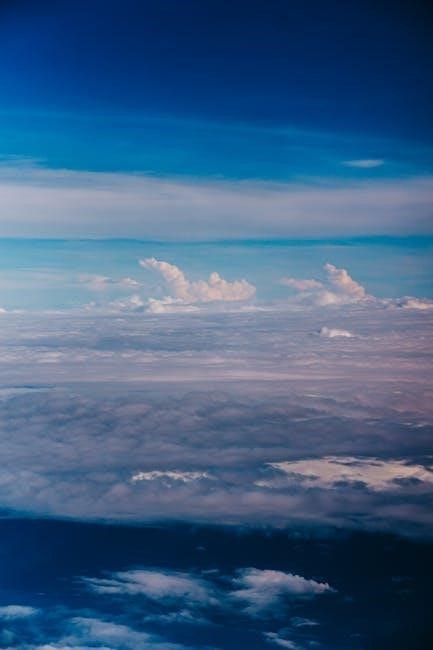
The Mesosphere: Meteors Burn Up
Worksheets highlight that most meteors vaporize within the mesosphere due to friction with air molecules, creating stunning visual displays in our skies.
Altitude and Temperature of the Mesosphere
Mesosphere altitude typically extends from roughly 50 to 85 kilometers (31 to 53 miles) above Earth’s surface, positioning it above the stratosphere and below the thermosphere. Worksheets frequently ask students to identify this layer based on its altitude range.
Temperature dramatically decreases with altitude within the mesosphere, reaching the coldest temperatures in the atmosphere – around -90°C (-130°F). Educational materials emphasize this cooling trend as a key characteristic.
Understanding these parameters is vital for completing matching exercises and comprehending the unique conditions present in this atmospheric region, as presented in many atmospheric layer worksheets.
Mesopause: The Coldest Layer
The mesopause represents the boundary between the mesosphere and the thermosphere, and it’s characterized by the lowest temperatures found anywhere in Earth’s atmosphere, plummeting to approximately -90°C (-130°F). Worksheets often highlight this extreme cold as a defining feature.
Identifying the mesopause requires understanding its position as the temperature minimum, a concept frequently tested in atmospheric layer assessments. This layer isn’t easily defined like others, making it a challenge.
Educational resources and worksheets emphasize the mesopause’s role in atmospheric dynamics and its importance in understanding the transition to the hotter thermosphere above.
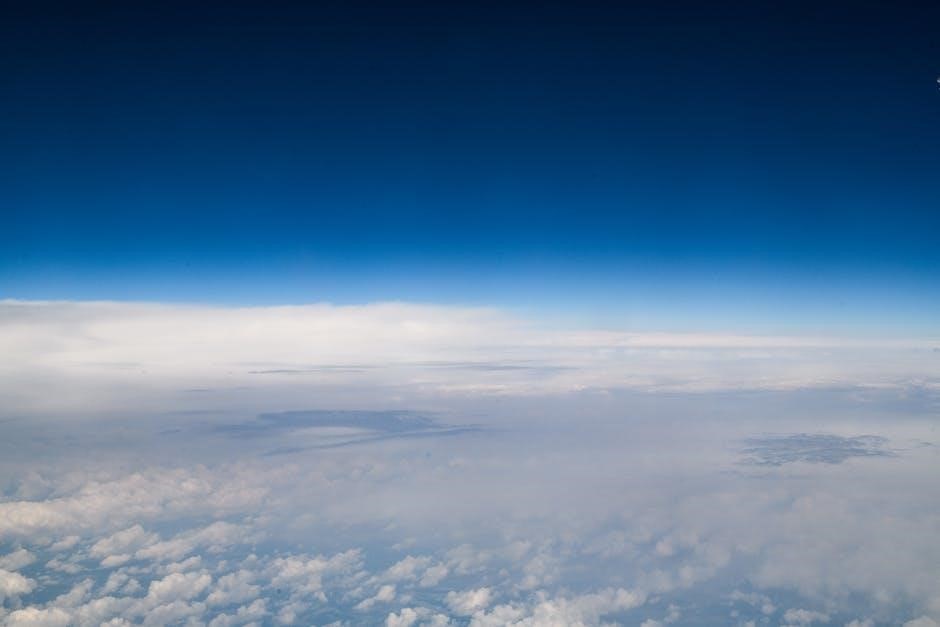
The Thermosphere: Radio Waves and Satellites
Worksheets explore how the thermosphere, and its ionosphere, reflects radio waves, enabling long-distance communication, and supports numerous orbiting satellites.
Altitude and Temperature of the Thermosphere
Worksheets frequently ask students to identify the thermosphere’s expansive altitude, generally ranging from 80 to 600 kilometers (50 to 372 miles) above Earth’s surface. This layer is characterized by a dramatic increase in temperature with altitude, potentially reaching 2,000°C (3,600°F).
However, despite the high temperature, it wouldn’t feel hot due to the extremely low air density. Exercises often involve converting between miles and kilometers, reinforcing understanding of scale. Students also learn how solar activity significantly influences thermospheric temperatures, creating variations in its upper boundary.
Ionosphere and Radio Wave Reflection
Worksheets commonly explore the ionosphere, a region within the thermosphere, and its crucial role in radio communication. This area contains ionized particles – atoms stripped of electrons – due to solar radiation. These ions enable the reflection of radio waves back to Earth, facilitating long-distance transmission.
Activities often involve tracing the path of radio waves and identifying which layers (D, E, F layers) are responsible for reflection at different frequencies. Students learn how solar flares and geomagnetic storms can disrupt the ionosphere, impacting radio communication systems globally.

The Exosphere: The Outermost Layer
Worksheets highlight the exosphere as the farthest layer, hosting many satellites and gradually merging into outer space with decreasing atmospheric density.
Altitude and Characteristics of the Exosphere
The exosphere begins approximately 300 to 600 miles (480 to 965 kilometers) above sea level, representing the outermost atmospheric boundary before transitioning into interplanetary space.
Worksheets emphasize its extremely low density, where atmospheric gases like hydrogen and helium are sparse and can escape into space.
Temperature varies greatly, but can reach high levels due to direct solar radiation, though the air is too thin to retain much heat.
This layer lacks a clear upper boundary, gradually fading into the vacuum of space, making it a unique and challenging region to study.
Satellites in the Exosphere
Many satellites, including those for communication and observation, orbit within the exosphere due to its minimal atmospheric drag.
Worksheets often depict the exosphere as hosting a significant number of spacecraft, benefiting from the reduced resistance compared to lower layers.
However, even in this thin atmosphere, some drag exists, requiring occasional orbital adjustments to maintain satellite positioning.
The exosphere’s high altitude also provides a clear view of Earth and space, ideal for remote sensing and astronomical observations, making it a crucial orbital zone.
Worksheet Focus: Matching Layers to Descriptions
Common exercises involve pairing atmospheric layers – troposphere, stratosphere, mesosphere, thermosphere, exosphere – with their defining characteristics, like weather or radio wave reflection;
Identifying Key Features for Matching
Successful completion of atmospheric layer matching worksheets hinges on recognizing unique identifiers for each region. Students must connect layers to descriptions like “closest to Earth, where weather occurs” (troposphere) or “contains high ozone concentrations” (stratosphere).
Understanding that meteors burn up in the mesosphere, and radio waves reflect in the ionosphere (thermosphere) are vital clues. Recognizing the exosphere as the outermost layer, hosting many satellites, is also key.
Worksheets often present features like altitude ranges (e.g., 30-50 km) or temperature profiles, requiring students to correlate these with the correct atmospheric layer. Careful attention to these details ensures accurate matching.
Common Matching Exercises in Worksheets
Typical worksheet exercises involve matching atmospheric layers (troposphere, stratosphere, mesosphere, thermosphere, exosphere) with their defining characteristics. These often include descriptions of altitude ranges – for example, associating the troposphere with the lowest altitudes.
Another frequent task requires linking layers to specific phenomena, such as matching the stratosphere with the ozone layer’s presence or the mesosphere with meteor combustion. Students may also match layers to aircraft flight zones (stratosphere) or satellite orbits (exosphere).
Furthermore, worksheets commonly present a list of features and ask students to identify which layer they belong to, reinforcing understanding of each layer’s unique properties and functions.
Atmospheric Gases and Puzzles
Worksheets integrate puzzles to identify gases present in each layer, enhancing learning through interactive activities and reinforcing atmospheric composition knowledge.
Identifying Gases Present in Each Layer
Worksheets frequently challenge students to pinpoint the dominant gases within each atmospheric layer, fostering a deeper understanding of their unique compositions. The troposphere, closest to Earth, is primarily nitrogen and oxygen, crucial for life. Ascending to the stratosphere, ozone becomes prominent, absorbing harmful UV radiation.
The mesosphere contains diminishing oxygen and traces of other gases, while the thermosphere exhibits increasing concentrations of atomic oxygen and helium. Finally, the exosphere, the outermost layer, features extremely low densities of hydrogen and helium, gradually merging into space.
Puzzle-based activities often require students to match gases to their respective layers, solidifying their comprehension of atmospheric stratification and chemical properties.
Puzzle-Based Learning Activities
Worksheets incorporating puzzles enhance engagement and reinforce learning about atmospheric layers. Crossword puzzles challenge students to define key terms like “mesopause” or “ionosphere,” while word searches highlight important gases like ozone and helium. Matching exercises pair layer descriptions – “where almost all weather is created” – with their corresponding names.
Diagram-labeling activities require students to identify the boundaries between layers and their associated altitudes. These interactive puzzles promote critical thinking and problem-solving skills, making the complex topic of atmospheric science more accessible and enjoyable.
Successfully completing these puzzles demonstrates a solid grasp of atmospheric structure and function.

Resources for Further Learning
NASA’s website (nasa.gov) offers extensive information, images, and videos about atmospheric layers, alongside educational worksheets and engaging classroom activities.
NASA Resources on Atmospheric Layers
NASA provides a wealth of resources for educators and students eager to delve into the complexities of Earth’s atmospheric layers. Their website, nasa.gov, serves as a central hub for the latest news, stunning imagery, and informative videos related to space exploration and aeronautical research.
Specifically, NASA offers educator guides like the “Where in the Air” classroom activity, designed to enhance understanding through hands-on learning. These resources often incorporate worksheets focusing on identifying key features of each layer, matching descriptions to altitudes, and exploring the gases present within them.
Furthermore, NASA’s materials frequently highlight the importance of the ozone layer, jet stream dynamics, and the role of the thermosphere in radio wave propagation, providing a comprehensive learning experience.
Educational Worksheets and Activities
Numerous educational worksheets focus on mastering the layers of the atmosphere, commonly employing matching exercises. Students are tasked with correlating layer names – troposphere, stratosphere, mesosphere, thermosphere, and exosphere – with their corresponding descriptions, such as altitude ranges and unique characteristics.
These activities often challenge learners to identify where key phenomena occur, like weather formation in the troposphere or meteors burning up in the mesosphere. Puzzle-based learning, including identifying atmospheric gases, reinforces comprehension.
Worksheets frequently emphasize the ozone layer’s importance and the stability of the stratosphere for jet aircraft flight, solidifying understanding of each layer’s role.